Instead of reading, you could also just listen:
Words have power: they connect or divide.
They work like double-edged swords: potentially hurting yourself and others.

Words go in two directions:
- What we hear or perceive as input
- What we say or produce as output
Both ways of words have specific pitfalls.
The next post will deal more with the input side!
This time we focus on the output of communication: What we say.
Let’s get practical
You might know the saying: “Stick and stones will break my bones, but words will never hurt me.”
This proverb is wrong, it is a lie!
Negative words hit hard.
When you are frequently put down, you tend to live out the sentiment, that was attributed to you. Somebody who is frequently called a liar, might in the end accept the judgement and just … lie.
They struggle to imagine a time/ world where that statement is not true.
And then, they might give in and accept the negative picture and close the door for any change.
Words have power: they connect or divide. Here they have divisive power!
What is our default mode?
Generally, we tend to make rapid judgements about situations, actions and finally words. This is because we want to keep ourselves safe.
Unfortunately, this quick thinking and especially quick responses to situations and to words can actually hinder good communication. When we expect judgement and communicate judgement, the recipient of our words can respond defensive. This then can trigger a ping-pong between accusation and defence: rather a confrontational approach, then cooperation.
Words have power: they connect or divide.
Is there another way?
Yes, there is!
It is called “non-violent communication”.
This strategy was developed by Marshall Rosenberg. This is one approach for dealing with situations, that have a chance to escalate. He aims to use the power of words to connect, rather than to divide.
-

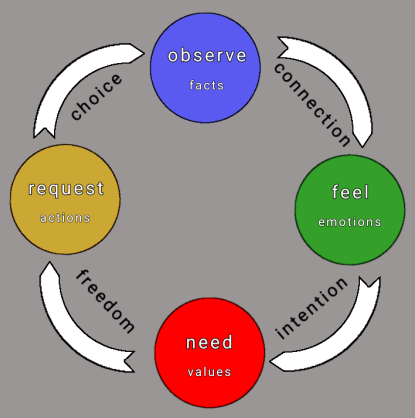
Circle of non-violent communication
In this approach, we take four distinct steps to improve our active sending of words:
Step 1 Observations:
Observation would mean to state concrete facts about what you see or hear without evaluation or judgement. For example, instead of “You’re always late,” you might say, “I noticed you arrived 20 minutes after our agreed time”.
Your observation of the specific situation triggers feelings unconsciously, before the other even can react.
Step 2 Feelings:
You could force yourself to pause before responding. The goal is to identify and name your own specific emotions (e.g., “I feel frustrated” or “I feel lonely”). They differ from thoughts or interpretations of others’ actions (e.g., “I feel ignored”).
You are allowed to feel anything. However, you do not need to live out your feelings.
The feelings that arrive are triggered by the situation, not necessarily caused by it!
The value of your feelings is that they are translations of your needs.
Step 3 Needs:
Connecting your feelings to universal human needs, such as safety, respect, or autonomy. In the concept of non-violent communication, posts that all human actions are motivated by an attempt to meet these shared needs.
Step 4 Requests:
Now you have reached a moment in the response, when you would want to make clear, positive, and actionable requests for what would enrich your life. Staying with your needs is something else than making demands. When we share our needs, the other is allowed to deny them. A request is distinguished by a willingness to hear “no” without retaliation.
Words have power: they connect or divide. When we open up about our needs, we open the door to connection.
What does this entail?
In any moment, there are two ways how you can enhance connection and understanding:
(1) vulnerably express our own feelings, needs and requests or
(2) empathically listen to the feelings, needs and requests of the other.
The background is the idea that my needs are valid, and your needs are valid.
With this in mind, we dare to perform the scary step of presenting ourselves vulnerably.
An example from the outpatient clinic
Imagine you have called the child and their parent in the waiting room.
You offer an inviting handshake, but instead they hide behind the parental leg.
What do you need?
For them to open up, and to becoming willing to cooperate for the examination shortly.
What do they need?
Space that they can get accustomed to your presence.
Time to check you out.
Predictability, so they know what to expect next.
How do you want to manage the situation?
Frequently, doctors just ignore the child’s’ avoidance and speak to the parent instead. The thought here is, that the child can observe us and their parents interacting and can come to terms with our presence.
Non-violent communication approach
Instead of ignoring them, I validate their presence and emotion:
- First, I observe the situation: what is objectively happening right now? → child afraid, avoidant
- Then, I ask myself how it makes me feel: angry, frustrated, pressured → aim to remain calm and inviting, to continue to offer a connection to the child, without invading their space.
- Next, I identify what need I have: the child to give me a chance, them to engage in the greeting
- Finally, I ponder for a second what the best way would be to voice my request in a way that influences them without hurting them: → Quite often, I do play hide-and-seek around the parental legs for about 10 seconds (they don’t need longer to feel the oddness of that encounter!) Then I verbalize the emotion that I see them displaying non-verbally: ” I see that you …”
Often the verbalization helps significantly. When they feel seen and respected, they dare to look at me.
Then I will explain to them the next steps: “I have something cool I need to show you … I have a television, where you can see your ears.” This offers the child predictability.
Deceptively simple decision
As we have seen before, nobody sees the world like we do. Therefore, we would need to express our feelings and thoughts with the goal, for the other to gain insight.
On the other hand, we do need to be open for the other person’s feelings, thoughts and needs as well. Children communicate this via non-verbal signs. We would have to learn to read their communication!
With practice, the tool of non-violent-communication helps us to navigate within ourselves. The effect is to transform blame and judgment–where neither our own needs nor those of the other person are likely to be met–into a mutual awareness of human needs.
What is the effect?
Words have power: they connect or divide
When we can stay true to ourselves, we can enter the clinic environment as authentic persons. This would offer a strong connection with the child and their parents.
Previous post Next post
Podcast Real – life video Patient-feedback
Connect Respect Engage Extra tips Contact/About me
Communication lives on comments … fancy to share yours?