Instead of reading, you could also just listen …
The power of eye-contact: Everybody needs to be seen. We are creatures of relationships, and we need interaction. If COVID-19 taught us anything, then that: Everybody needs to be seen.
Too little or too much eye-contact?
Although everybody must be seen, there is also a balance between too little eye contact (“the doctor didn’t even look at me, while doing the examination”) and too much (“I felt stripped naked under the gaze”).
This experience is true for children as for adults. Children must also be seen. They are longing for proof that they matter and that they have a value.
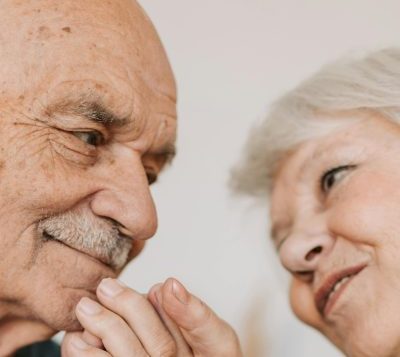
An illustration of eye-contact:
Let me tell you a personal story:
I remember arriving for the very first day in the nursery in a city my family had just moved to. My mother brought me along, and after we had entered the hall, the nursery schoolteacher approached us, she squatted down and greeted me. She talked to me at eye level, and I was immediately taken in by her approach.
I loved to be seen and to be taken serious, although I was just 4 years old. I can still remember the warm feeling of acknowledgement and welcome in this gesture.
The power of eye-contact: Control
Eye contact is quite intimate, even over far distances.
If I see that you see me, I can’t hide. I can try to ignore you, but I have no control and I cannot make you stop looking at me. In that way, eye contact also contains a link with controlling the situation or not. A typical statement in this context is: “I see everything that happens in here.” or “I see you …”. In these words lie intimacy and control, connection and power.
The power of eye-contact: Connection
Another function of eye-contact is to establish a solid contact between sender and receiver of information. We often demand eye-contact, when the information is so important, that it needs to be transferred completely: “Look at me because I really need you to listen to what I say”.
Here, eye-contact enhances auditory contact and helps to focus the attention.
The power of eye-contact: Threat
Eye-contact also has another effect: in the animal world, eye-contact can already be a form of attack. It can either precede the action of chasing or can be used as staring down the weaker party. The individual who looks away first has lost the game and accepts to be inferior.
When the child expects me to be an enemy, my gaze will feel mostly like a threat to them. Me looking at them must have bad consequences in their imagination.
There is a fine line between “to be seen” and “to be exposed”. The later leads to a sensation of shame and the need to hide.
The power of eye-contact: in the hospital setting
During my practice, I often observe that children are frequently looking away, when I discuss their role in the treatment plan. They try to ignore the fact that they need treatment in the first place and afterwards, they try to ignore the fact that they will need to contribute to the healing process (by the way, adults tend to do the same!).
In my observation, sick children can worry that others might not make a difference between their body letting them down and themselves letting their parents down. They show behaviour that is in line with being exposed and receiving judgment. When I keep looking at them, they regularly avoid my view.
In another post, I will explore the difference between being sick and being “guilty” further, but for now, it is important, that there is a link here, that leaves us very sensitive to stares when we are sick.
In a nutshell:
- We experience eye-contact over as long-distance as an invitation for interaction.
- Being stared at can feel like an attack.
- We perceive the gaze of others more intensely when we are sick and vulnerable.
Communication lives on comments … fancy to share yours?