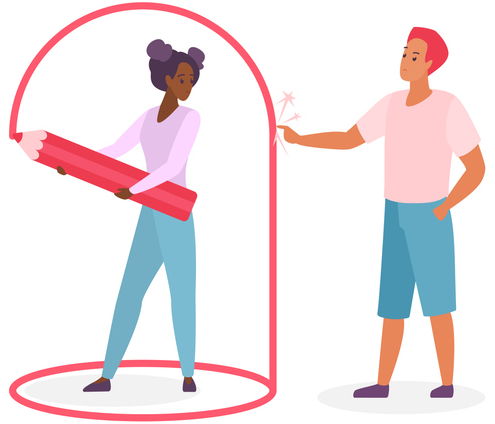
Doctors are constantly transgressing boundaries.
Different parts of the body have a different level of significance for us.

For example, the hands are the area of first encounters with a stranger.
We shake hands, we touch someone, we reach out.
In most situations, it is OK to be touched on the hands.
You could say that hands are the minister of foreign affairs of the body.
What about the rest of the body?
All other parts of the body are more intimate.
Any touch from the periphery of the body more towards the core triggers an increasing raise in alertness or possibly even in fear.
This hierarchy starts from the extremities towards the core of the body, the neck and towards the head.
The closer to the head and any orifice the examination takes place, the more intimate it becomes.
Last not least, any opening of the body is highly private.
Those areas are “mine”.
Any contact here needs permission, by me!
In general, touching here would be allowed in by “invitation only”.
And when these boundaries are crossed?
Doctors are constantly transgressing boundaries.
Imagine a stranger gently touches your hand.
Most of the time, that would be OK, but what if the same person then pats you on the shoulder.
That would be a little odd coming from a stranger, but also OK.
But what if this stranger now pats your knee…
What is going on here?
What is their agenda?
This really starts to feel awkward.
Even more so, if that person now gently touches your face while pushing some hair out of your eye or touches your neck.
Entering the private space!
Although none of these interactions is physically painful, but the closer, the stranger gets to your core parts, this interaction feels more and more as a transgression of your personal boundaries and therefore invasive.
Doctors are constantly transgressing boundaries.
Doctors constantly transgress boundaries!
One of the challenges any doctor faces is, that we need to do exactly this, we need to intrude the personal space of any patient to complete our examination.
Doctors are constantly transgressing boundaries.
Here are some examples:
- We palpate the thyroid by touching the neck
- We listen to the lung by exposing the chest
- We palpate the abdomen and expose the core
With adult patients, both parties silently agree to perform the examination.
They knew (vaguely) what would be involved when they came to the appointment, and they accepted some degree of inconvenience in the process.
Adults accept that doctors are constantly transgressing boundaries.
What are the consequences for examining children?
With the paediatric patient, examinations can get easily complicated.
Also with children, doctors need constantly to transgress boundaries.
When my patient has already decided that I am an enemy, anything I do while transgressing personal boundaries is just confirming their judgement and the whole appointment turns almost into “torture” for the child (and in consequence as well for me).
A child who feels threatened by my can either try to fight, flight, or freeze within about examination.
Children acting out
Children, who try to flight out of the encounter, are immediately spotted.
Also, any child who sees me as an enemy and decides to fight me, is easily identified.
As I will explain later in the post “Engage: The child’s perspective of authorities” the doctor needs to decide at this stage, whether the result of the examination at this very moment is worth the fight.
Children freezing during assessment
It becomes more difficult to spot that the examination is emotionally traumatic for the child, if the child does not put up a fight but rather freezes.
In “freeze mode” the child might be mistaken for being cooperative because it does not resist the examination.
Initially, that might be helpful for the medical specialist. They can perform the steps that need to be done. On the other hand, this means that the child is learning, that it has no right to establish boundaries or to protect itself.
In those cases, the medical specialist should wonder if this reaction is really a healthy emotional response or a more learned submission to the imposed will of a stranger.
How to spot the difference?
The difference between cooperation and freeze would be:
- the first child engages and interacts with the doctor
- the second child allows being passively handled
In a nutshell:
As soon as we touch more than the hands of the patient, we are trespassing personal boundaries.
Doctors need constantly to transgress boundaries, we need to be careful, while doing that.
Previous post Next post
Connect Respect Engage Extra tips Contact/About me
Communication lives on comments … fancy to share yours?