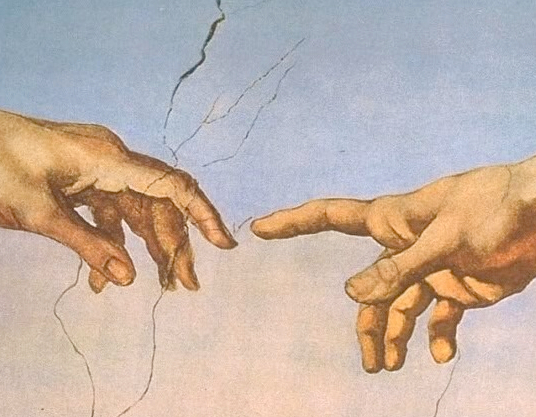
The hands are the point of first contact.
Seeing something triggers imagination.
When the emotional base-note of our perception is already tuned towards fear, we easily imagine that anything we see, will be dangerous.
The first step of torture is to just show the instruments, the brain does the work of terror.
As a conclusion: seeing can enhance fear.
Seeing versus touching
In contracts, something that we have touched, is under our control. Therefore, this thing we have in our hand is far less threatening than something that we only have seen!
The English phrase of “getting a grip on something” is very true. Getting a grip stands for security, predictability and finally control.
How does this related to our body parts?

Regarding the hierarchy of our body-parts, the hands have the role of “minister for foreign affairs”. They are the tools with which we explore the world. Therefore, if we want to decide whether something is dangerous or not, it helps when we might get a “grip” on it to understand it completely. When we explore something with our hands, we are in control.
What are the practical implications?
In practical terms: I try to make the first physical contact with the child via the hands.
First, I offer a handshake and when that is refused, I offer at a later moment a “high five”.
Many children are thrilled (and flattered) when I offer them any form of greeting, and they frequently go along with it.
What if they don’t want to shake my hand?
Even if the child refuses initially to touch me, this is not a problem. In that case, I just respect their decision of “not touching me”. I typically say, “OK, you don’t want to shake hands? That’s fine with me!” At that point, even withdrawn children are often surprised to learn that their wish not to be touched right away is acceptable.
What then?
If a child refuses to shake my hands, I typically just continue to introduce myself. Further, I tell them what to expect next and, last not least, I tell them about my “ear-television“.
As a result, they dare to take a better look at me, although maintain their “safe” distance.
By allowing them their time to visually assess me, their need for pacing of the interaction is considered, and often they become willing to interact with me, just a moment later, when they have become curious about the prospect of seeing their ears and showing them of!
In a nutshell:
The hands are the point of first contact.
Just seeing anything strange in a new environment triggers fear, to get a grip on things helps to reduce fear.
Connect Respect Engage Extra tips Contact/About me
Communication lives on comments … fancy to share yours?