Instead of reading, you could also just listen …
Nobody likes uncertainty, but we have to live through it together.
We want to have control of the world, or at least predictability.
We crave certainty and this is evident in any conversation about disease, treatment, and health issues.
Ambiguity terrifies us.
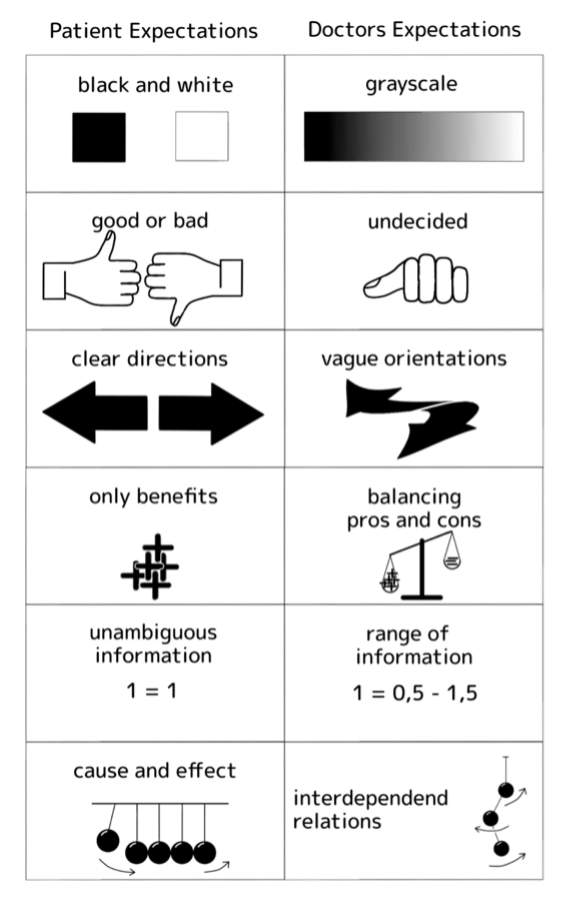
Different expectations
Patients and doctors come with different expectations to this topic.

We as healthcare providers often cannot give the patient and their parents the clear-cut statements they are longing for.
This “failure” might be perceived as “incompetence” and in this case, might lead to ”doctor-hopping”, skipping from clinician to clinician searching for the one perfect answer.
Examples of uncertainty
Examples of these “failures” are:
- Risks of surgical interventions
- Possible side effects of treatment
- Sensitivity of test results
- Specificity of test results
- Positive predictive value
- Negative predictive value
- Long-term effects of treatment
- The effect of waiting on the disease
Need for certainty
Nobody likes uncertainty, but we have to live through it.
The patients and their parents long for predictions during time of distress caused by illness.
Unfortunately, I could not yet find any medical school that offers a course of clairvoyance in their curriculum. Otherwise, I would have followed this immediately. As medical professionals, we learned to live with uncertainty. In contrast, our paediatric patients and their parents are just starting their journey into this aspect of life.
What do they need?
Nobody likes uncertainty, but we have to live through it. This leaves us with a demand.
We might need to acknowledge that we cannot provide certainty. While we do this, we should not leave them in the rain alone.
What would you want in a moment of uncertainty? Would it not be nice if someone comes alongside you? Someone, who just remains there with you.
Our patients long for us to indicate possible next steps in their journey.
What can we do?
What we can do, is:
- to explain our limitations
- to provide a sketched perspective
- to explain everything in a way that can be understood easily, as described under “How to deal with complexity”.
Challenging patients ideas
We would need to counter the patient’s expectation of simplicity and clear-cut decisions.
This is a moment in the conversation when we will cause cognitive dissonance. Only when the base of the interaction is stable, only when we have managed to create a solid foundation of trust, then we have a chance to guide the patient through this scary ambiguity.
Practical tips
- Step one: bring the uncertainty above the table.
- Step two: break down the chances/ risks into tangible concepts for parents and children.
- Step three: deal with the fact that our brains are not good at processing percentages (better to use a phrase like “one of a hundred similar patients” rather than 1%)
- Step four: Acknowledge the persistence of uncertainty
Nobody likes uncertainty, and we have to live through it together.
Most important step:
Whenever possible, explain “warning signs” when further action would be needed. What would be the circumstances, when our plan might need to be revised?
This way, we provide some hedging for the parents’ anxiety. We also involve them as partners. Allowing the parents a role as partners deals with their sense of helplessness. They are with the child all the time, and they will notice these early warning signs. If the communication is based on trust, they will get the sensation that we are in the situation together.
As nobody likes uncertainty, we still have to live through it together.
In a nutshell:
Nobody likes uncertainty, but we have to live through it.
Connect Respect Engage Extra tips Contact/About me
Communication lives on comments … fancy to share yours?