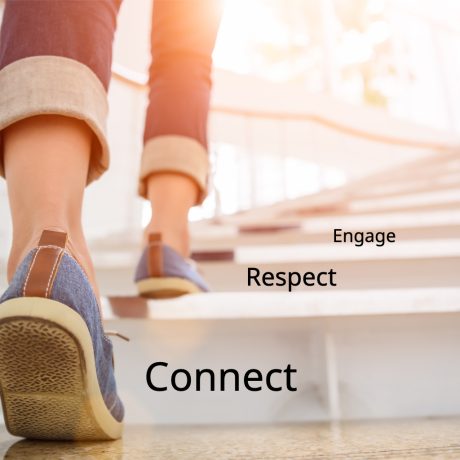
Connect – Respect – Engage are the three steps needed for a successful consultation.
What’s the problem?
The majority of doctors are aware, that so called “bed-manners” are important. Unfortunately, instructors and medical school struggle to teach this skill.
It is often perceived as a talent or natural gift, rather than as a trainable skill, that can be developed.
The teachings about communication regularly only focusses on “bad-news” conversations. Also, books about the communication between doctors and patients come up with up to 75 different types of communicative skills.
What’s the principle?
In my opinion, the communication process can be brought back to three basic steps:
- Connect
- Respect
- Engage
These are the steps needed to have a pleasant, successful, and efficient interaction with (paediatric) patients and their parents in the outpatient department.
All three steps are necessary, in this order, to initiate a fruitful interaction.
In the following posts I will highlight different practical and directly applicable steps for all of them.
Before we dive into the details, let’s have a closer look at, what I mean with the three headings:
- Connect
- Respect
- Engage
What do I mean by “Connect”?
To connect stands for “being in the same mental space”, “being together in the here and now” and avoiding or mitigating distractions such as fear or non-alignment.
What does “Respect” stand for?
In the interaction between doctors and paediatric patient, it is important that both parties speak the same language. This does not only relate to the use of interpreters for any patient without sufficient English proficiency. All conversations happen in a mental space. We need to make sure, that medical terminology is adjusted and that we use age appropriate images when we explain complex medical systems.
The burden for this side of the communication lies with the medical specialist. It is just not good enough, to complain, that the patient is “too stupid to understand” the problem. Whenever we feel like, they are missing the plot, we would need to take a (mental) step out of the consultation and need to search for another way to provide an explanation.
Only when we speak “the same language” we have any chance that the information that we provide throughout the consultation is actually obtainable by the patient and the parent.
What is the point of “Engage”?
To “Engage” stands for the process of exchange of information, jointly developing a treatment plan and altogether to empower the paediatric patient and their parents to become an active partner in their journey to improved health.
We know that the outcomes for treatment are better, when the patient “buys-in”, but frequently, they are only just told by us what they need to do, according to guidelines and standard procedures.
The result is that only about 30% of the patients adhere long-term to the suggested interventions.
What now?
Connect – Respect – Engage are the three steps needed for a successful consultation.
With the clear, identifiable phases, it becomes possible to teach “bed-side” manners to inexperienced colleagues.
The following chapters will cover the practical aspects of “Connect – Respect – Engage”.
The goal of this approach is to empower your patient, to make them real partners in the doctor-patient relationship.
In a nutshell:
“Bed-side-manners are no accident, but teachable when they are broken down into three steps as Connect – Respect – “Engage.
Connect Respect Engage Extra tips Contact/About me
Communication lives on comments … fancy to share yours?