Instead of reading, you could also just listen …
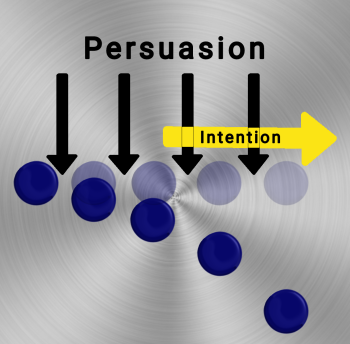
Persuasive communication initiates change.
What is persuasive communication?
According to Wikipedia Persuasion is defined as:
“Persuasion or persuasion arts is an umbrella term for influence.
Persuasion wants to influence a person’s beliefs, attitudes, intentions, motivations, or behaviour. “
The American Psychology Association gives the following explanation:
Persuasive communication is:
Information that is intended to change or bolster a person’s attitude or course of action and is presented in written, audio, visual, or audiovisual form.
Persuasive communication and change management
To initiate change, we need to use persuasive communication.
As I have mentioned before, any treatment would require change to some extent.
Altering the instinctive strategy of your patient is a key part of any conversation between the doctor and the (paediatric) patient.
What forms of change might be required?
Either the patient (parent):
- needs to start something new
- take a pill
- alter the diet
- start an exercise
or
- is required to stop certain behaviour
- fewer sweets / fizzy drinks
- no more use of cotton buds
- stop self-destructive actions
Persuasion is the process through which we aim to alter the patients’ behaviour. Our aim, to help them to make changes themselves, will be more effective when we shift the patient’s concept from helpless recipient to empowered partner in this process.
The drag of the old
Any change of a routine demands initially a conscious effort until the “new” becomes the “new normal”. This conscious effort during the transition consumes energy. In most situations, it seems easier to stick to the old way, than to try a new path. Also, the results are rarely immediately noticeable, but require a period of investment before the result becomes evident. This lack of immediate benefits can ruin the motivation for the effort.
Persuasive communication initiates change. And the majority of us doctors do this badly. For example, we know, that only about 30% of patients adhere long term to treatment requests. Why? In my opinion, the causes are the drag of the old routine and the delay in noted benefits.
The traditional dynamic laid bare
- There is a problem with the patient’s health
- The patient and parent respond to the problem
- They noted that they cannot solve the problem alone
- They seek our professional support
And now?
We are like the teacher, who tells them off for not knowing how to avoid troubles.
We act and they just hold still. The assumption is that our action will dissolve the problem into thin air. Among ourselves, we know that this is often not the case.
Recipient or partner?
The obstacles for change are most noticeable, when the patient “waits” for us to “improve things”, when he or she remains the passive recipient of the treatment. In their opinion, it is our job to cure them, while they just hold still!
This attitude might be true if we want to remove a splinter, but not for obesity, any form of addiction or anger management. In the mentioned examples, the patient does the “treatment” themselves, at least partially.
When we need to activate the patient and parent as partners, we need persuasive communication to initiate this change.
An empowering approach
The empowering approach considers that the paediatric patient and their parents come with their own competence for problem-solving. This is part of their own medical belief systems. They know their circumstances better than we do. They know where the obstacles for any change lye.
Persuasive communication initiates change in our paediatric patients and their parents. The questions are now:
- Are we willing to invest in their understanding of the problem.
- Are we willing to empower them as partners?
Shift in our mindset needed first
The new aim for us would be to learn how to help the patient (and parent) from their perspective. How can we manage the treatment process with us as supporting actors and them as the main characters?
Here a shift in our mindset is needed: We would need to utilize the capacities the patient (and parent) possess to solve problems.
If we do this step, we need to be interested in their strategies. As guides with knowledge about bodily functions, we can help them to understand the mechanics of their disease with the goal to shifting the patient’s concept from helpless recipient to empowered partner.
In a nutshell:
The strategy of persuasive communication is the main tool to initiate change.
Communication lives on comments … fancy to share yours?